Almost Won? Here's Why That Feeling Is the Most Dangerous Moment in Casino Gaming
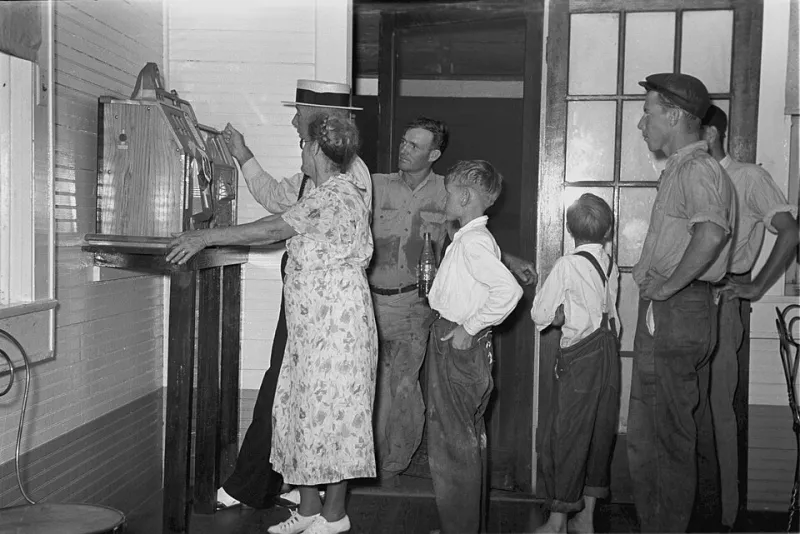
Photo: Russell Lee, Public domain, via Wikimedia Commons
You're three spins deep into a slot session. Two jackpot symbols land perfectly. The third reel slows. It teases. It stutters. And then — one symbol off. Your stomach drops. Your hand hovers over the spin button before you've even processed what happened.
That moment? It was designed. Every millisecond of it.
At Cocoa Casino, we're big on helping players enjoy gaming for what it actually is — entertainment with real stakes. And one of the most important things any player can understand is the psychology of the near-miss. Because once you see it clearly, you can't unsee it. And that awareness might be the most valuable tool in your bankroll management arsenal.
What Is a Near-Miss, Exactly?
In casino terms, a near-miss is any outcome that feels close to a win without actually being one. On a slot machine, it's two-out-of-three matching symbols. In blackjack, it's busting at 22 when the dealer shows a six. In roulette, it's your number's neighbor hitting instead.
The key word here is feels. Objectively, a near-miss is just a loss. Your bankroll doesn't know the difference between landing zero matching symbols and landing two. But your brain absolutely does — and it reacts in a way that's almost indistinguishable from actually winning.
Researchers at the University of Cambridge found that near-misses activate the same reward circuitry in the brain as genuine wins. Dopamine — the chemical your brain releases during pleasurable experiences — spikes during near-misses almost as strongly as it does when money actually lands in your pocket. Your brain essentially lies to you, filing a near-miss under "progress" rather than "loss."
How Casinos Engineer the Almost-Win
This isn't a conspiracy theory. It's documented game design. The practice became so prevalent in the US that several states have regulations specifically limiting how often near-misses can appear on slot machines. Nevada, for instance, prohibits slots from being programmed to produce near-misses at a rate disproportionate to the actual odds of winning.
But within legal limits, game designers absolutely lean into this mechanic. Here's how it works on a modern video slot:
Weighted reels: High-value symbols appear more frequently on the first reel than the third. This means you'll see that jackpot symbol land on reel one all the time — setting up the anticipation — while it's statistically rare on the final reel. The math is clean. The emotional experience is anything but.
Slow-spin animations: That dramatic deceleration on the final reel isn't a technical limitation. It's a deliberate animation choice that extends the near-miss moment, giving your brain more time to get invested in the outcome.
Sound design: The ascending tones that play as reels lock in matching symbols? They're engineered to build tension. Some games even play partial win sounds during near-misses, blurring the line between winning and losing at an auditory level.
Live dealer games and table game software use subtler versions of these mechanics — a dealer flipping over a card that nearly makes your hand, or a roulette ball that circles the rim of your number before settling next door.
Why Your Brain Keeps Falling for It
Humans are pattern-seeking creatures. We evolved to find meaning in sequences of events, which was genuinely useful for survival. But in a casino environment, that same instinct becomes a liability.
When you experience a near-miss, your brain doesn't conclude "that was a loss." It concludes "I'm getting closer." This is called the gambler's fallacy — the belief that past near-misses make future wins more likely. They don't. Each spin is statistically independent. But the feeling is real, and it's powerful.
There's also something called loss-chasing behavior, which near-misses actively trigger. After an almost-win, players consistently report a stronger urge to keep playing than they feel after a clear, decisive loss. A near-miss doesn't feel like a conclusion. It feels like an interrupted story — and your brain wants to finish it.
Practical Strategies to Stay in Control
Knowing the mechanism is half the battle. Here's how to use that knowledge at the tables and the slots:
Name it when you see it. Seriously — when you hit a near-miss, say to yourself (or out loud, if you're playing at home): "That was a loss. A designed loss." It sounds almost too simple, but labeling the experience accurately disrupts the emotional response.
Set a spin or hand limit before you start. Decide before your session begins how many spins or hands you'll play, independent of outcomes. Near-misses are most dangerous when you're playing open-endedly. A firm stopping point removes the near-miss's power to extend your session.
Build in mandatory pauses. Every 20 minutes, step away for two minutes. Make a coffee. Check your phone. The near-miss effect depends on sustained emotional momentum — breaking that rhythm resets your perspective.
Track your actual balance, not your feelings. Keep a running note of where your bankroll stands. Near-misses create a distorted sense that you're "almost there" — real numbers on a screen cut through that distortion fast.
Set loss limits with real teeth. At Cocoa Casino, we always recommend setting a session loss limit before you start — and treating it as a hard stop, not a suggestion. If near-misses are pulling you toward "just one more spin," a pre-committed limit is your best defense.
The Bottom Line
Casino games are built to be engaging. That's not inherently sinister — entertainment is supposed to be engaging. But near-misses sit in a specific psychological gray zone where the experience of "almost winning" is deliberately amplified to keep you at the machine or table longer than you planned.
Understanding that mechanism doesn't ruin the fun. If anything, it makes you a smarter, more self-aware player. You can still enjoy the drama of a slow-spinning reel or a dealer's suspenseful card flip — you'll just know exactly what's happening in your brain when you do.
Play with your eyes open, set your limits before the session starts, and remember: an almost-win is still a loss. Your bankroll knows the truth, even when your dopamine doesn't.